




YB Mad and the 'land scandals'
Residents in Ampang allege that Umno Cempaka state assemblyperson Mad Aris Mad Yusof is involved in at least eight land scandals.
Residents in Ampang allege that Umno Cempaka state assemblyperson Mad Aris Mad Yusof is involved in at least eight land scandals.
 While the senior lawmaker, who has also been an Ampang Jaya municipal councillor since 1992, has denied this, residents suspect that he has abused his power to alienate many reserve land plots in Ampang for commercial purposes.
These include green belts, school reserves, irrigation and drainage reserves, road reserves, buffer zones and empty land. The land plots were alleged to be leased out to his cronies and the latter have in turn re-rented it out to other companies for a higher price.
The frustrated residents also submitted a memorandum to Prime Minister Abdullah Ahmad Badawi demanding that Mad Aris be removed from the line-up of the last general election.
However, he was fielded and elected for a fourth term.
Malaysiakini will carry Mad Aris’ comments in the final part of this three-part series.
The ‘scandals’
From the information provided by local residents, gathered from memorandums and complaint letters, Malaysiakini compiled at least eight alleged land scandals. These are:
1. The Millennium Curry House restaurant at Jalan Nirwana, Taman Nirwana.
2. The Light Industrial Zone located between the Middle Ring Road 2 (MRR2) and Kampung Pandan Dalam.
3. A furniture showroom 'Perabut Cempaka' at Jalan Cempaka 3, Taman Chempaka.
4. The Light Industrial Zone at Jalan Nirwana 10, Taman Nirwana.
5. The Pandan Puri Corporation plant nursery at Jalan 1, Taman Putra Sulaiman.
6. A demolished food court beside SMK Pandan Indah.
7. A driving range in Pandan Perdana and;
8. Three-storey houses in Taman Chempaka near the Star LRT station.
Below is the chronology surrounding two of the cases.
Light Industrial Zone
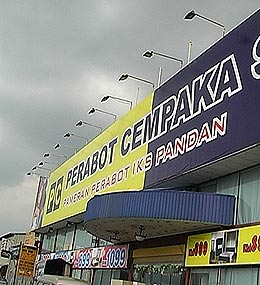 The 1,500 square metre light industrial zone located between the MRR2 and Kampung Pandan Dalam was originally a buffer zone set aside by the developer for public amenities.
After it was handed over to the Ampang Jaya Municipal Council (MPAJ), the council gave approval in 2000 to develop it with the support of Mad Aris as Pandan state representative.
Currently it is operated by a private company, Pandan Puri Corporation Sdn Bhd, and accommodates over a dozen garages, a furniture showroom and others.
This stretch of industrial zone is located close to the Kampung Pandan housing area, with no road or pathway between the garages and houses.
This had drawn flak from the residents as their daily life had been affected by the noise from the garages which are often open until late night.
However, English daily The Sun reported on Nov 26 last year that the development was supported by the state government.
“The state government has a policy of allowing development in buffer zones in accordance with the suitability of the area,” said state secretary Ramli Mahmud in an e-mail reply, adding that it could bring extra revenue for the MPAJ.
Food court
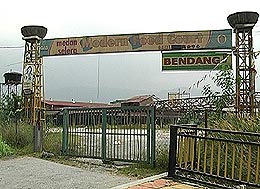 In another case, a four-acre food court beside SMK Pandan Indah was proposed by a private company in 2002 with the support of Mad Aris and Gerakan state assemblyperson for Teratai, Yap Soo Sun.
The company obtained written approval from the Federal Land and Mines Department (PTG), MPAJ and the school authority to lease the school reserve land to build a food court.
Not long after the food court started to operate, it faced strong protests from parents due to pollution.
After the school authority retracted its support and PTG decided not to renew the contract, the food court was demolished.
Although this issue came to an end, questions continued to linger. Why did the town council allow a four-acre food court to be constructed next to a school? What were the reasons which prompted Mad Aris and Yap to support the project?
More importantly, how could school reserve land be leased to a private company to build a food court?
‘Monkey business’
Chairperson of the Taman Nirwana Phase 1 and 2 Residents' Action Committee, M Thomas, 52, told Malaysiakini that initially, the land plots were reserved for public facilities before they were commercialised.
 “A few years after the land was handed over to the local council, the monkey business started. The land plots were secretly converted for commercial and private usage. The residents only realised it when the development projects started.”
According to him, the commercial development of reserve lands will affect the area's living standard and housing prices. He added that commercialising the land reserved for drainage widening will result in flash floods.
Kampung Pandan Progressive Youth Association Chairperson Isa Mahadi, 37, complained that fields reserved for local youths to play football and even the prayer room in Pandan Utama had to give way to private development.
Thomas, who has been active in residents' associations for more than 14 years, pointed out that the commercialisation of reserve land started following the 1999 polls.
He urged MPAJ to explain why there was no consultation with local residents when approving the land conversion and why most of the privatised land were operated by the same company.
Malaysiakini learnt that the land developed for the light industrial zone along MRR2, the furniture showroom 'Perabut Cempaka', the plant nursery and the driving range were all managed by Pandan Puri Corporation Sdn Bhd.
According to a report by The Sun on Jan 21 last year, the director of this company was Mohammad Abdullah, 49, who is also the president of the Malay Hawker and Petty Traders Association's Hulu Langat branch.
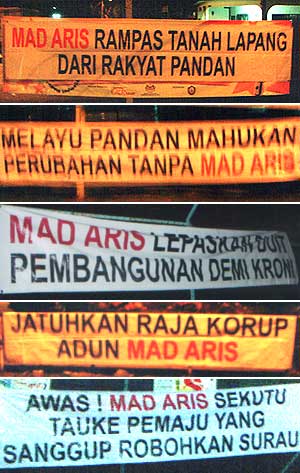 The other directors are Jalaluddin Zainal Abidin, 54, Nasir Saian, 47, and Abd Samat Mohd Ali, 43. Jalaluddin headed a sub-committee in the branch to 'acquire' the land plots while Abd Samat is the treasurer and Nasir an ordinary member.
Although some residents allege that Mad Aris was behind the land conversions, they could not furnish any concrete proof besides linking the conversions to his portfolio in the government.
‘Just like a secret society’
Mad Aris was elected as state assemblyperson in1990 and appointed as a MPAJ councillor in 1992. He is also a member of the Hulu Langat district land committee.
According to procedure, the district land committee is responsible for the approval of land conversion applications but this must be eventually endorsed by the state exco.
Local councils also play a role in conversions as buildings or development on the said land plots need approval from the council. Opinions of elected representatives from the ruling party will usually be sought as they represent the residents.
Based on this, Thomas alleged that Mad Aris had abused his power and with the support of the state government, managed to privatise the land for personal gain.
“He pushed the land committee to agree to the conversions. MPAJ is only in charge of administration and maintenance, whereas the conversion of land is always mooted by a politician.
“There was no open tender, no proper documentation. We don't know how much the private company is paying, and where does this money go? They handle it like a secret society,” said the angry resident.
The residents have complained to MPAJ, Mad Aris, Selangor Menteri Besar Dr Mohd Khir Toyo, Abdullah and even the Anti-Corruption Agency but most of the issues remain unresolved.
Part 3 will be published tomorrow


